Surface Acoustic Waves in Nanostructures and Emerging Materials
Details
| Presenter: | Mingyun Yuan |
| Title: | Surface Acoustic Waves in Nanostructures and Emerging Materials |
| Affiliation: | Paul-Drude-Institut für Festkörperelektronik, Leibniz-Institut im Forschungsverbund Berlin e.V. |
| Date: | 27.08.2026 |
| Time: | 17:00 h |
| Place: | Building C (ZEVS), third floor, room "Kolloquium" |
Contents of the Talk
Surface acoustic waves (SAWs) are mechanical vibrations traveling along the surface of a solid. They can be envisioned as earthquakes on a chip. SAW devices play versatile roles in hybrid nanostructures thanks to their high frequencies, affinity to the surface, and the dynamic nature of their strain fields, which can be exploited for particle manipulation and sensing. Apart from conventional semiconductors, exploration of emerging materials and novel nanostructures can lead to higher electromechanical coupling and wider bandwidths for SAW devices functioning as key elements in 5G/6G networks. In this talk, I will first illustrate examples of SAW control and probing in nanostructures. By acoustic manipulation of excitons in (Al,Ga)As double quantum wells, we show a pathway towards electromechanical control of single photon sources. SAW-propelled "flying" excitons enable the remote pumping of single impurity centers. Time-resolved measurements confirm that the SAW pumping leads to GHz single-photon emission rate, desirable for quantum communication applications in quest of high data rate. In addition to spectroscopic characterization, we can visualize sounds using atomic-force microscopy (AFM). Images of SAW propagation and scattering in epitaxial monolayer graphene on SiC indicates a waveguiding effect, with graphene serving as an atomically thin acoustic waveguide. Thanks to the high spatial resolution, we observe rich wave patterns in the graphene waveguide including ray splitting and branched flow that are closely related to quantum chaos.
In the second part I will talk about our effort focused on aluminium nitrides incorporated with transition metals. (Al,Sc)N has attracted much attention due to the enhanced piezoelectricity resulting from Sc incorporation. At PDI, we have developed a universal process to synthesize (Al,Sc)N thin films on diverse substrates using plasma-assisted molecular-beam epitaxy (PAMBE) for GHz SAW applications. Using the layered structure of (Al,Sc)N thin films on specific substrates, multiple SAW modes with strong coupling are generated, gearing towards efficient acoustic integration in dissimilar systems such as nanomechanical resonators and spin centers.
Through this seminar the audience will be introduced to the complex interplay of SAWs with a variety of nanostructures and the critical role played by materials study.
Short CV
Dr. Mingyun Yuan earned her B.Sc. from Fudan University in Shanghai, China, and her Ph.D. from Dartmouth College, US. She worked as a Postdoctoral Researcher at TU Delft, the Netherlands before joining the Paul-Drude-Institute (PDI) in Berlin as a Scientist.
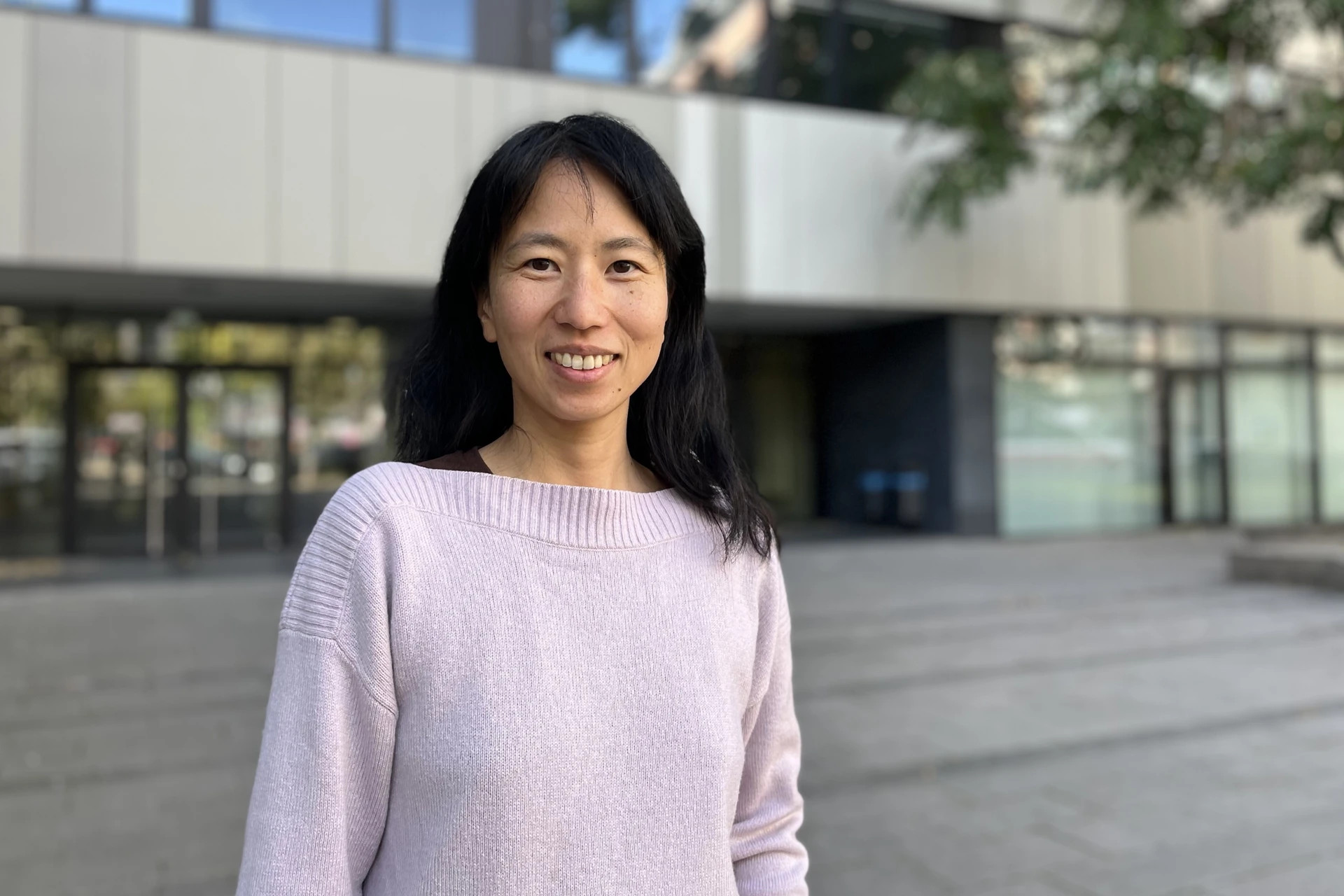
© Photo: Paul-Drude-Institut für Festkörperelektronik (Link)