What if...? Futuring Meets Biomagnetic Sensor Systems
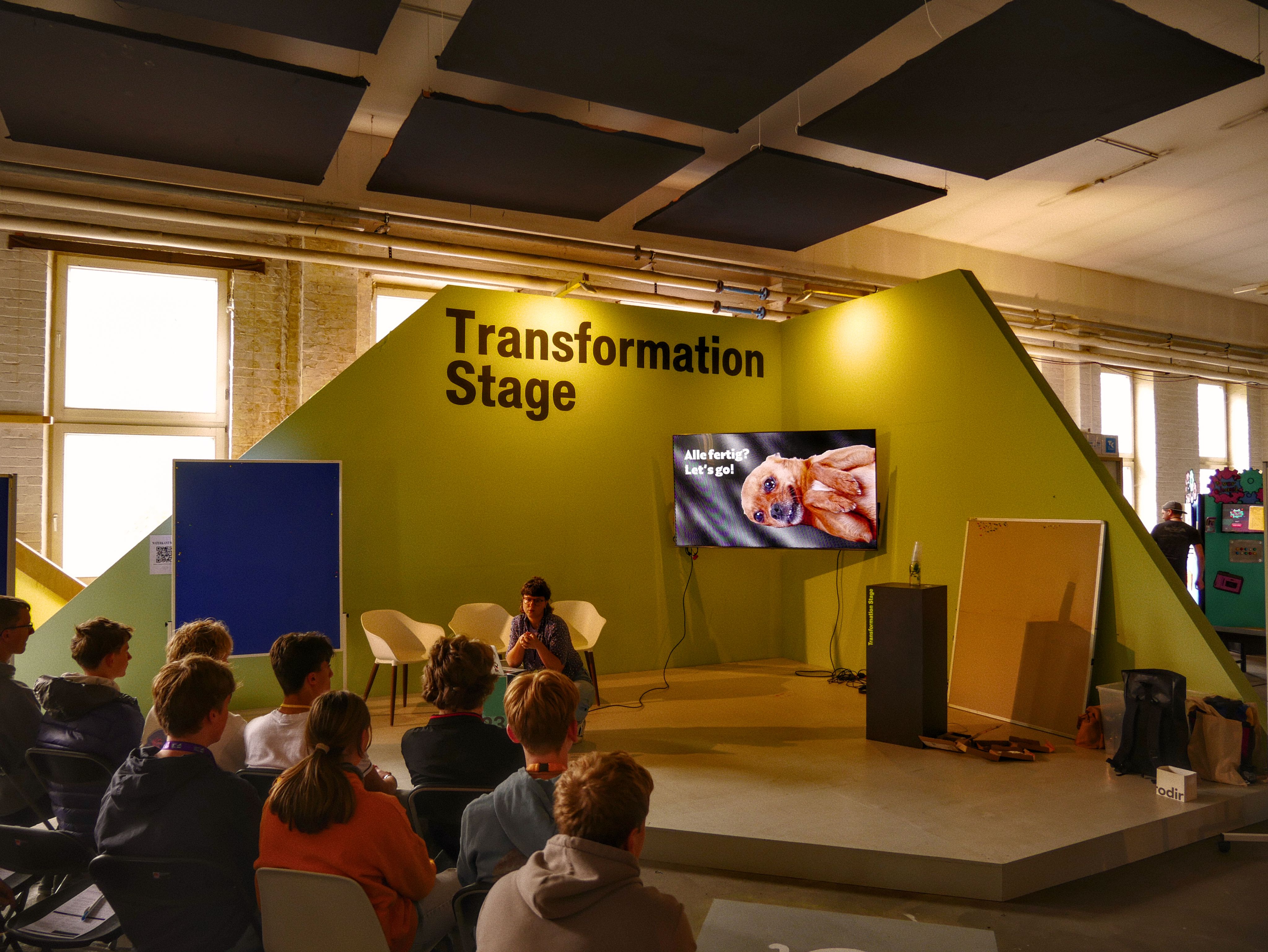 What if a biomagnetic mirror could reveal not only our outward appearance, but also our fitness level or stress level? Or what if intelligent sensors could tell me how my cat is feeling at any given moment? And where do the opportunities - but also the limits - of such technologies lie? These were precisely the kinds of questions explored by a group of abaout 20 school students at the Young Waterkant Festival on June 17th at the MFG5 site in Kiel. The festival is aimed at young people between the ages of 14 and 18 and gives them the opportunity to explore future-oriented topics from science, technology, and innovation in interactive workshops. It was here that the outreach team of Collaborative Research Centre 1261, together with the design agency Futures Probes, piloted a futuring workshop for the first time.
Futuring is an approach to science communication that does not merely explain research, but invites people to reflect together on possible futures. The workshop was based on four speculative future scenarios involving biomagnetic sensing: from assistive systems and biomagnetic mirrors to emotion recognition as part of security infrastructure and the health monitoring of pets. The participants discussed which developments they considered likely, which ones they would like to see become reality, and what societal questions these technologies might raise.
CRC doctoral researcher Henrik Wolframm provided the scientific link to current research, offering insights into biomagnetic sensing and illustrating which of the ideas behind these visions of the future are already being investigated scientifically today. This made one thing clear: some scenarios are still quite far removed from current research reality, while others are less like science fiction than one might initially assume.
The workshop was a first pilot and received very positive feedback from the participants, with an average rating of 8.5 out of 10 points. The implementation of the workshop and Henrik’s presentation were highlighted as particular strengths. At the same time, the accompanying evaluation provided several suggestions for further developing the format, for example regarding the way in which the workshop should be promoted.
Over the coming months, the futuring module will be further developed jointly by Futures Probes and the CRC and used at additional events. The aim is not simply to communicate science, but to spark curiosity and invite people to think together about possible futures—and about the role that research can play in shaping them.