
Magnetic Localization Lab
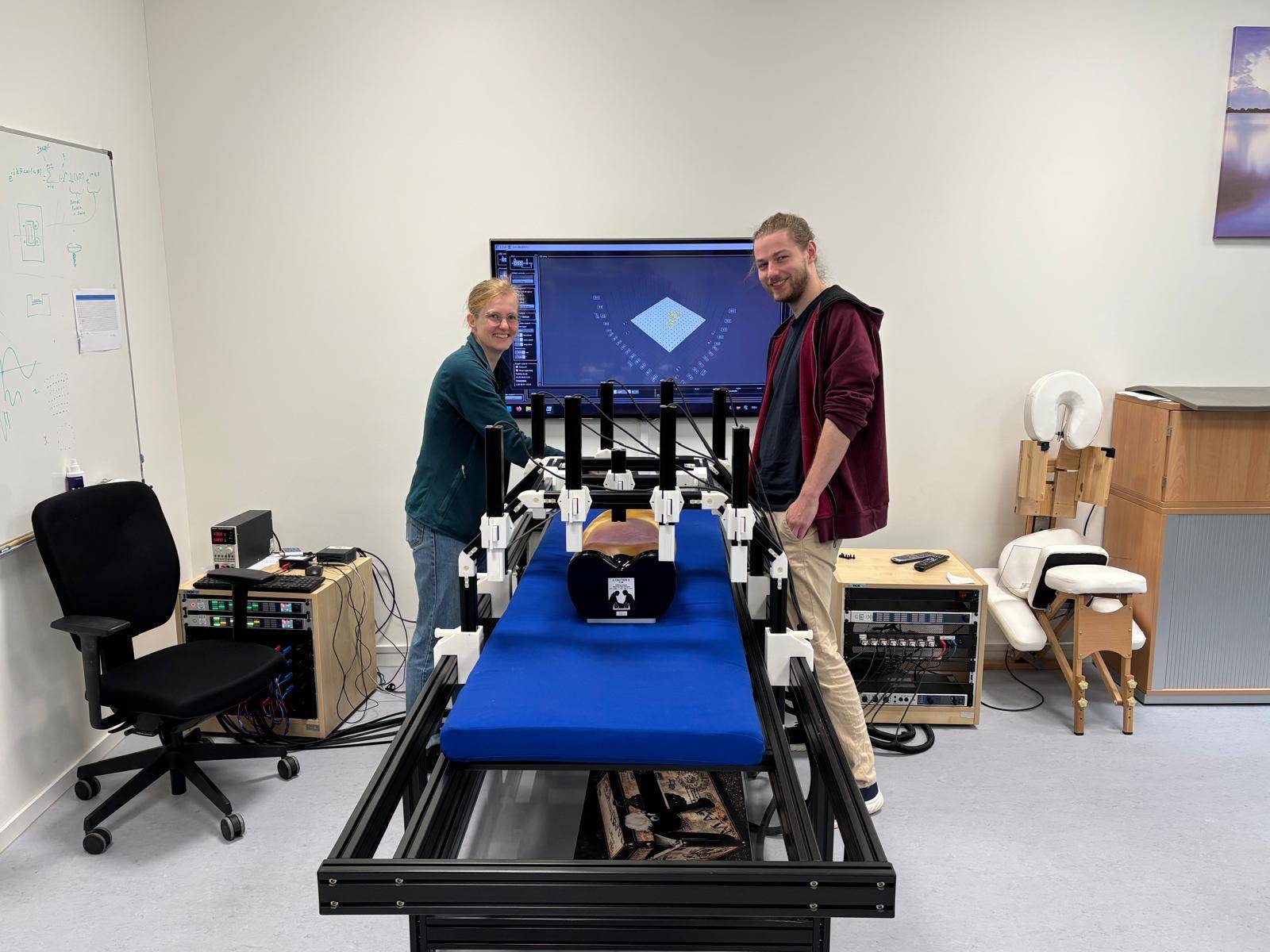 The magnetic localization lab is designed to enable real-time localization of magnetic sensors and actively driven magnetic sources in three-dimensional space. The system is developed within the context of biomagnetic sensing and targets applications in medical tracking, such as ultrasound probe positioning and endoscopic navigation.
At its core, the lab provides a controlled measurement environment for investigating localization strategies within a defined volume of approximately 50 cm × 50 cm × 50 cm. The setup is specifically tailored to support flexible experimental configurations and the integration of different sensor and actuator technologies.
The lab supports two primary modes of operation. In the first mode, magnetic sensors are localized using externally generated magnetic fields. For this purpose, eight three-dimensional excitation coils are mounted around a patient bed, generating well-defined magnetic field patterns. These fields allow precise detection and positioning of magnetic sensors placed within the measurement volume.
In the second mode, actively driven magnetic sources are localized. These sources, such as coils or capsule-like devices generating alternating magnetic fields, are detected using a configurable sensor array system. A movable arc mounted to the patient bed carries eight vertically adjustable sensor groups, each consisting of three orthogonally arranged sensors, enabling spatially resolved magnetic field measurements.
Future extensions of the lab include the integration of large Helmholtz coils to allow contactless excitation of magnetic sources, further expanding the range of experimental scenarios.
The magnetic localization lab is particularly relevant for medical applications requiring precise spatial tracking. Potential use cases include the localization of ultrasound probes to improve spatial referencing of acquired images, as well as the tracking of endoscopic devices, where accurate knowledge of the sensor position can support reconstruction of anatomical pathways and identification of regions of interest.
While the hardware infrastructure is largely established, ongoing work focuses on the development of real-time capable localization algorithms and system integration. Future developments will also address combined operation modes, in which sensor arrays are themselves localized and used simultaneously for source localization.
| Further details | |
|---|---|
| Place | Building C, room 01.xxx |
| Experienced lab users | M.Sc. Sören Lange |
| Responsible PIs | Prof. Dr.-Ing. Gerhard Schmidt |