Sensor Evaluation Lab
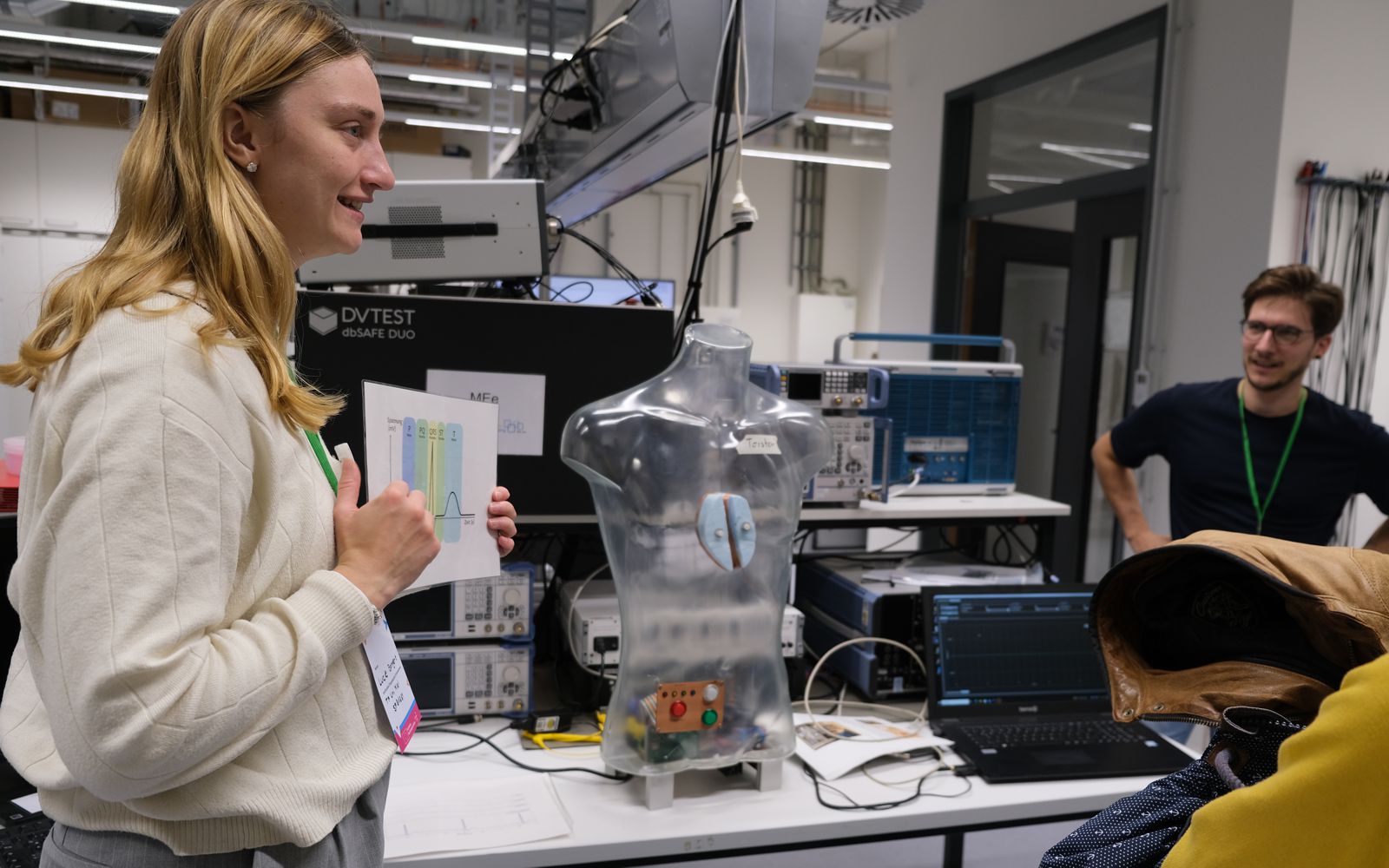 The sensor evaluation lab provides access to state-of-the-art instrumentation specifically designed for the detection and quantification of extremely small electrical as well as magnetic signals. These highly sensitive measurement systems enable CRC researchers to investigate signal behavior across a wide range of frequencies, from true baseband signals up to modulated carrier frequencies. This flexibility allows for comprehensive analysis of both static and dynamic sensor responses under controlled laboratory conditions.
A central capability of the laboratory lies in the precise evaluation of electronic circuits associated with magnetic sensing systems. Custom-built and commercial measurement setups allow detailed characterization of amplification stages, filtering concepts, and signal conditioning electronics. This makes it possible not only to assess sensor performance itself, but also to optimize the entire measurement chain, ensuring that noise contributions from electronics are minimized and well understood.
A particular focus of the laboratory is the generation of highly controlled, extremely small magnetic fields using calibrated air-core coils. These coils are designed to produce homogeneous and reproducible magnetic field distributions over a defined volume, enabling systematic sensor calibration and testing. By carefully controlling current sources and coil geometries, magnetic fields can be generated with high precision over a broad frequency range, which is essential for determining sensor sensitivity, linearity, and frequency response.
In addition, the laboratory is equipped for detailed noise analysis of magnetic sensors. Measurements are carried out in both electrically and magnetically shielded environments to suppress external disturbances and reveal the intrinsic noise characteristics of the devices under test. This includes the investigation of noise spectral densities, low-frequency drift, and stability over time. Such measurements are crucial for applications where sensors are required to detect signals at or near the physical noise limits.
To further enhance measurement quality, the laboratory includes dedicated test stations specifically developed for the characterization of magnetic field sensors. Each station is equipped with its own custom-designed shielding system, optimized to reduce magnetic, electric, and even acoustic interference to a minimum. These shielding systems provide near-ideal experimental conditions, allowing sensors to be evaluated without significant environmental perturbations.
The shielding systems are complemented by low-noise current sources, precision positioning systems, and automated data acquisition platforms. This enables repeatable and high-throughput measurements, as well as systematic parameter sweeps. Sensors can be tested under varying orientations, field strengths, and temporal conditions, providing a comprehensive understanding of their performance.
Beyond standard characterization, the facility also allows for the investigation of advanced topics such as sensor cross-sensitivity and long-term stability. Environmental parameters can be monitored and, in some cases, actively controlled to study their influence on sensor behavior. This makes the laboratory not only a testing ground but also a development platform for next-generation magnetic sensing technologies.
In summary, the sensor evaluation lab represents a highly specialized environment for the precise evaluation of magnetic sensors and their associated electronics. Through the combination of controlled magnetic field generation, advanced shielding techniques, and high-performance measurement systems, it enables accurate, reproducible, and low-noise characterization at the highest technical level.
| Further details | |
|---|---|
| Place | Building C, room 03.xxx |
| Internal phone number | xxxx |
| Responsible PIs | Prof. Dr.-Ing. Michael Höft Prof. Dr.-Ing. Robert Rieger |